
Projects
nMELTS: a Deep Learning Accelerated Thermodynamic Model for Silicate Magmas
SASE: Ben Thyer (Division of Geological and Planetary Science), SASE GRA Fellow
Thermodynamic modeling is often applied by geologists and planetary scientists to understand the magmatic and tectonic processes that form and characterize Earth and other planets; Such knowledge is essential for earthquake and volcanic hazard assessment and for geothermal and mineral exploration. MELTS (Ghiorso and Sack, 1995) is the preeminent software for thermodynamically modeling systems that include molten (or near-molten) silicate rock at pressures up to 3 GPa, but its application to complex magmatic systems, large geodynamic models, and inverse problems is limited by its computational speed and stability.
Thyer’s thesis, supervised by Dr. Paul Asimow, develops nMELTS, a neural-network emulator of MELTS that accelerates calculations by three orders of magnitude while avoiding the original model’s algorithmic instabilities. This speedup enables larger-scale geodynamic modeling and application to geochemical inverse problems, which aim to reconstruct the thermal and chemical structure of subsurface magmatic and tectonic systems that impart measurable geochemical signatures on rocks and magmas on the surface.
nMELTS takes chemical composition and thermodynamic state variables as inputs, then uses three interconnected networks to predict phase assemblages, compositions, and abundances. The reconstructed bulk composition is then used to refine the solution by solving a Linear Least Squares (LLS) problem to enforce mass balance and improve accuracy. This LLS refinement step accounts for over 99% of computational time and may appropriately be omitted for some applications when speed is prioritized. As of November 2025, nMELTS supports isobaric batch crystallization with a MELTS 1.0.2 emulator, but development continues to extend nMELTS to other thermodynamic controls (e.g. isentropic, isochoric, or isenthalpic calculations), fractional crystallization/melting, and additional thermodynamic models that are calibrated to different thermodynamic conditions (pMELTS and MELTS 1.2).
With the Schmidt Academy, Thyer is working to integrate nMELTS into PetThermoTools (Gleeson & Weiser, 2024), an open-source Python interface to MELTS, giving users a seamless way to switch between MELTS and nMELTS and evaluate performance for their needs. A secondary goal is the development of a lightweight web application to make MELTS more accessible to geoscientists with limited programming experience.
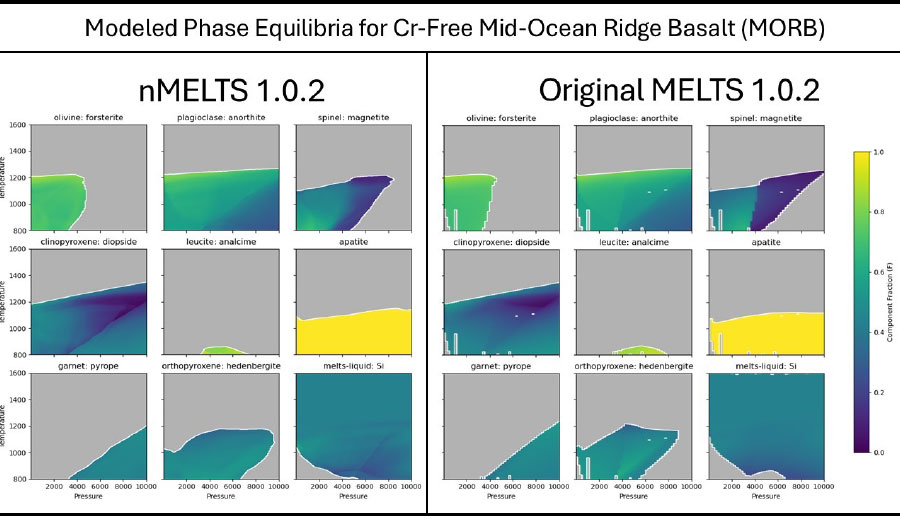
Figure: nMELTS and the original MELTS 1.0.2 model phase equilibria at variable pressure and temperature for mid-ocean ridge basalt (Allan et al., 1989), a common rock type that forms the bulk of oceanic crust on earth. Psuedosections of nine representative phases are plotted. These phases are predicted to be absent in the grey regions, and the stability fields of chemically variable phases are colored by the modeled abundance of a chemical endmember within the phase. Apatite is modeled as a chemically invariable phase in MELTS. These results show that nMELTS predicts phase assemblages and chemistry that are an excellent proxy for the original MELTS, but with orders of magnitude less calculation time. Additionally, The plots produced by the original MELTS contain visual evidence of algorithmic instability: some lower and mid-pressure calculations failed before the minimum temperature was reached.
Allan, J. F., Batiza, R., Perfit, M. R., Fornari, D. J. & Sack, R. O. Petrology of Lavas from the Lamont Seamount Chain and Adjacent East Pacific Rise, 10° N. J Petrology 30, 1245–1298 (1989).
Ghiorso, M. S. & Sack, R. O. Chemical mass transfer in magmatic processes IV. A revised and internally consistent thermodynamic model for the interpolation and extrapolation of liquid-solid equilibria in magmatic systems at elevated temperatures and pressures.
Contr. Mineral. and Petrol. 119, 197–212 (1995).
Gleeson, M. & Wieser, P. gleesonm1/PetThermoTools: PetThermoTools (v0.2.7). Zenodo. https://doi.org/10.5281/zenodo.10570547 (2024).